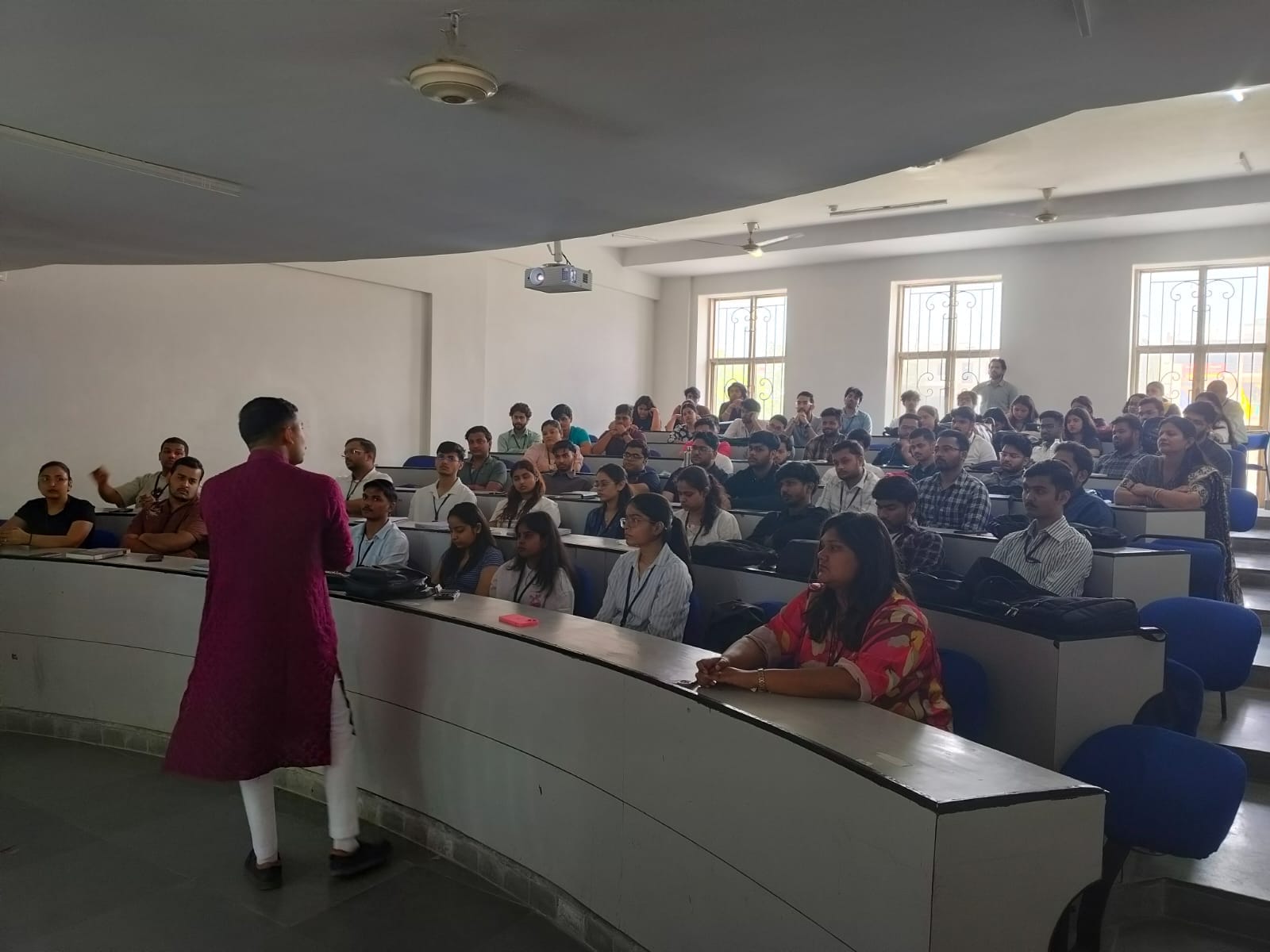
Speaking · Guest Lecture
Our Generation. Our Move.
Amity University, Lucknow
Listen · NotebookLM Podcast
A deeper dive into the ideas from this lecture, generated via NotebookLM.
You're the first generation in India that gets to choose quality of life over survival. That's a privilege. Here's how to use it well.
01
The Three Generations
India held roughly 24% of world GDP for nearly two millennia. Colonialism dropped that to 4.2% by 1950. That single number tells the story of why three generations lived the way they did.
Generation 1 — Survival (1947–1970s): Per capita income at independence was ₹249.6/year. Between 1947 and 1987, per capita GDP grew at just 1.6% per annum. The goal was to survive.
Generation 2 — Stability (1980s–2000s): Post-1991 liberalization changed everything. Between 1994–2013, real GDP per capita grew 142% — the fastest sustained growth India had ever seen. The goal was to stabilize — put a meal on the table three times a day.
Generation 3 — Quality of Life (Now): Per capita NNI reached ₹2,05,324 in FY 2024–25. India is projected to hit $5,000 per capita by 2030 — the level economists associate with a shift from essential to discretionary spending. One in four Indian households is projected to have meaningful discretionary spending power by 2035.
Your grandparents' generation fought to survive. Your parents' generation fought for stability. You are the first generation that gets to choose quality of life — and that's not a free pass, it's a responsibility.
02
The Responsibility That Comes With It
For people from comfortable backgrounds — don't consume employment, create it. Take the family business global. India has no globally recognized consumer brand born here and scaled like Samsung or Toyota. That's not a complaint. That's an open field waiting for someone willing to build.
03
Know Your Why Before Your What
Most people ask "What do I want to do?" before they've examined "Why do I want anything at all?" Is it money? Status? Impact? Family expectation? There's no wrong answer — but an unexamined answer will cost you years.
Start with Why, then decide What — startup, job, or family business. Then figure out How. Most of business school teaches the How. The Why is on you.
04
Value Is Not Just Money
When you evaluate an opportunity, score it across all seven dimensions — not just salary:
- Money — Yes, it matters. But it's one of seven.
- Respect — From people whose opinion you actually value.
- Network — Who are you in the room with?
- Execution — Are you doing things, or making slides about things others do?
- Experience — Real texture. Failures, shipping, difficult clients.
- Learning — Are you more capable every month, or plateauing?
- Optionality — Does this path open doors or close them?
A ₹6 LPA role with incredible network and execution experience might be worth more than ₹12 LPA where your boss's boss doesn't know your name.
05
Know Where You Are on the Pyramid
"Follow your passion" is great advice — if your family is already at safety and stability. If they're not, it's irresponsible. But if your parents already did the work to get your family there, don't waste that privilege by making the same safe choices they had to make.
They made those choices so you wouldn't have to.
06
Do the Right Thing
All of the above is strategy. But strategy without character is dangerous.
We created DIVINI — named the brand, did the full packaging. The work got recognized internationally by World Brand Design Society and Packaging of the World. Then someone with money came along wanting packaging for a tequila brand. The offer: 5× what DIVINI paid, in USD. Early days of the studio. Real money.
We said no. We didn't want to compromise the name Devalok was building. And we didn't want our team carrying the karmic load of someone drinking from something we designed and then getting in a car crash or hurting someone. That was our line. That became a foundational stone of Devalok.
You almost always know what the right thing is. The hard part isn't knowing — it's doing it when there's money on the table telling you to look the other way.
Your reputation is the one asset that compounds in every direction. Every time you do the right thing — especially when it costs you something — that compounds. Every corner you cut compounds too, just the other way. And you don't get to rebuild it cheaply.
07
Don't Compete on Price
India's per capita income is rising. People want quality — in B2C and B2B. The person who builds the premium version of anything in India right now has a 10-year runway ahead of them. Don't race to the bottom when the whole market is moving up.
Download · Student Takeaway
The one-page key takeaways handout shared with students after the lecture.
Download PDF
Make sure the picture in your head is actually yours. Then go build it — with integrity.
